
Intellectual Property in Game Art Outsourcing: NDAs, Copyrights, and Secure Workflows
Intellectual property security during art outsourcing requires a three-level approach: an NDA prior to initial brief familiarization, a complete transfer of rights in the contract, and restricted access on the contractor's side. Controlling the transfer of source files, verifying licenses, and the final deletion of data post-release eliminate all legal risks and guarantee clean project rights.
Legal foundations of IP protection in game art outsourcing
IP protection is divided into two stages. Before work begins, the game concept and plot must be secured against leaks, and after the assets are delivered, all rights to the visual content must be acquired.
What is the difference between an NDA and a Master Services Agreement?
An NDA regulates material confidentiality, while a Master Services Agreement defines the terms of art development and purchase. To safely show a contractor the Game Design Document for budget estimation, a game art outsourcing NDA is signed at the very beginning.
- The NDA restricts the distribution of concepts, lore, and mechanics, but does not make you the owner of the created graphics.
- The Master services agreement establishes the estimate, deadlines, revision procedures, and the transfer of art rights.
Only a combination of both documents guarantees project security — from the initial estimate to the delivery of the final files.
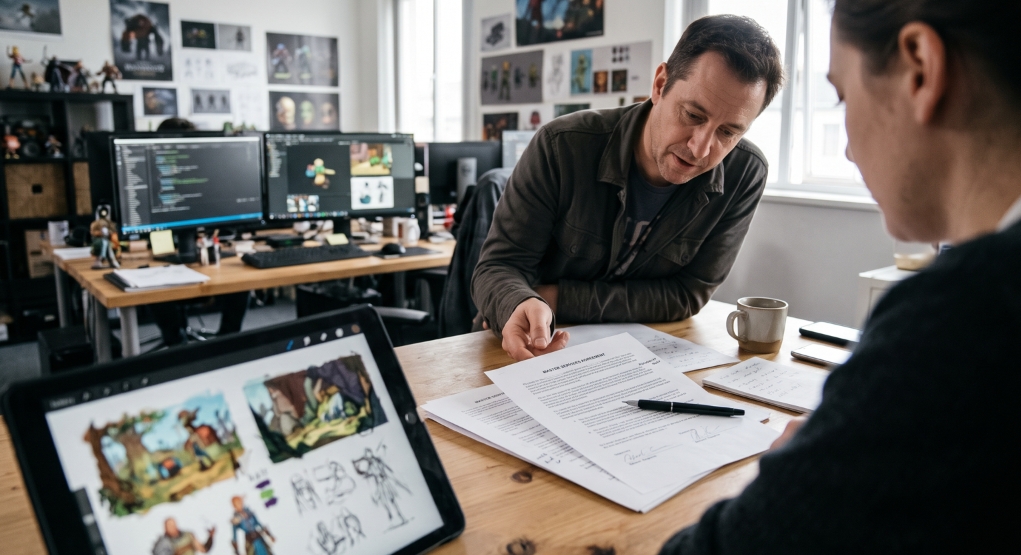
How does a work-for-hire clause guarantee full copyright transfer?
The work for hire agreement formula makes the client the sole owner of the developed graphics. For complete legal certainty, this is additionally reinforced by an intellectual property assignment clause.
- The list in the contract must cover all source files, textures, animations, and final renders.
- The formalized transfer of rights eliminates video game copyright risks long before the game's release.
- By ordering Game art services , you receive full rights to the created 2D/3D assets, while internal scripts and tools remain with the studio.
Such detailing eliminates ambiguous interpretations and guarantees the legal clarity of all game graphics.
Pre-production security before sharing your game design document
During project estimation, the contractor is granted access to internal documentation. Security at this stage consists of sharing only the data necessary for calculating labor costs.
What sensitive materials require protection during the estimation phase?
Everything that forms the uniqueness of the game and its commercial value must be kept hidden from unauthorized eyes.
- Game design document, lore, mechanics design docs, and text descriptions.
- Concept art, art directives, references, and UI mockups.
- Sketches of characters, environments, and world-building items.
This approach allows for obtaining an accurate budget and deadline estimate while preserving the project's commercial secrecy at all negotiation stages.
Securing the production pipeline and asset storage
During active production, security depends on access configuration, rules for saving changes, and the permissions granted to team members. Contractual obligations are backed up by technical restrictions at the level of working tools.
How do studios prevent unauthorized leaks during active art production?
Setting up role based access control restricts file editing and viewing strictly according to team roles.
- Version control system: version control access tracks the authorship of every edit and blocks access to the release.
- Leak protection: a portfolio embargo clause prohibits publishing art on social networks and portfolio platforms.
- Rights revocation: contractor accounts are deactivated immediately upon acceptance of the completed work.
The combination of these rules with technical restrictions reduces the risk of leaks to zero.
Who owns the raw source files, PSDs, and Spine 2D project directories?
The terms of source files ownership are agreed upon in advance: the client must receive not only the exported art but also all working projects for further edits.
- 2D sources: PSD files with the preserved structure of layers, masks, smart objects, and groups.
- 3D models: source Blender or Maya 3D projects with an unwrapped mesh and texture maps.
- Animation projects: Spine 2D directories with configured skeletal structures, rigging, and animation keys.
Sprite sheets or JSON are suitable for engine assembly, but do not allow adjusting layers or animation keys. Only a complete set of source files guarantees project autonomy.
AI generation, third-party references, and copyright compliance
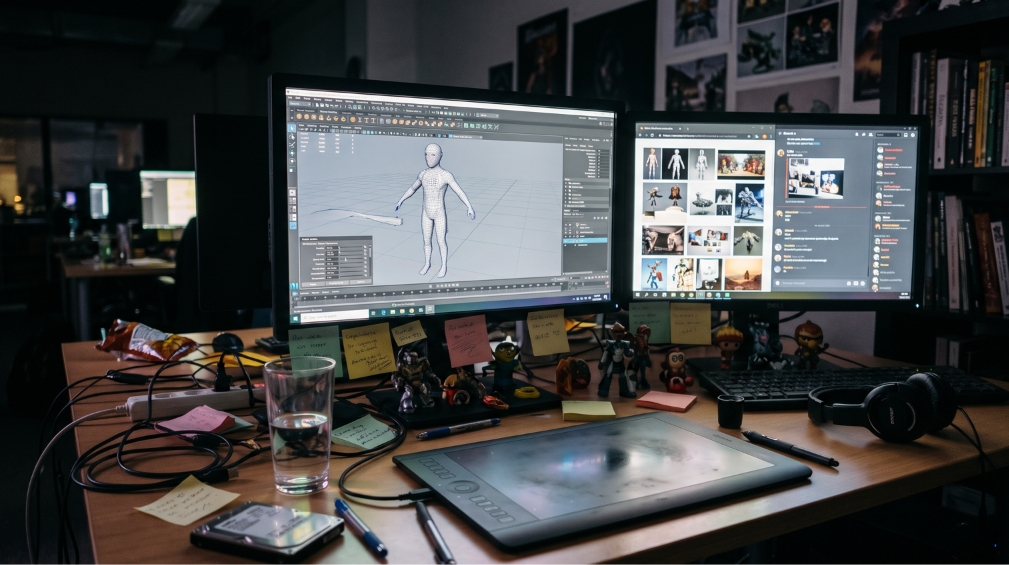
Copyright protection covers not only the final art but also all intermediate sources. An unlicensed texture or improperly used AI concept can block the game's publication.
How to avoid copyright infringement when using concept art references?
Implemented third party asset licensing allows maintaining a transparent registry of all involved materials.
- Use of references: third-party images serve as conceptual guidelines but do not make it into the final assets in the form of collages or copies.
- Generative art: ai generated art copyright rules oblige the studio to save the asset creation history and confirm the extent of manual labor.
- Platform control: compliance with video game copyright laws guarantees rapid clearance through compliance checks on console and mobile stores.
Auditing all sources during the development stage fully protects the client from intellectual property claims post-release.
Deliverables handover and post-project data retention policies
Closing the contract requires checking the completeness of source files and the final deletion of residual copies from the outsourcer's servers.
- Material delivery: handing over the complete set of source files with a check to ensure all files open correctly.
- Storage and deletion: an agreed-upon data retention policy establishes strict deadlines for destroying backup copies on the contractor's servers.
- Rights revocation: instant cancellation of all individual access to the client's internal task trackers and repositories.
Proper closure of development guarantees legal clarity and complete autonomy for the client in further graphics work.
How Paintpool Studio guarantees airtight IP security for your game projects
At Paintpool Studio, your project's security is secured in the contract and backed by strict infrastructural standards.
- Pre-start NDA: we ensure confidentiality prior to the first review of the game design document.
- Source files and rights: we transfer 100% IP for the created graphics along with PSD, Blender, and Spine 2D files.
- Closed loop: we adhere to the principle of clean room art production, limit access, and do not publish art in our portfolio without consent.
Partnering with Paintpool Studio for your game art production ensures you receive assets ready for integration with complete protection of your intellectual property.


